


Boulder's Vacancy Crisis Deserves Real Solutions

Dear Friends and Neighbors,
In my last newsletter, I promised a deep dive on the Boulder Valley Comprehensive Plan and Title 9, how our land use code works, where it's broken, and what we're doing to fix it. That's still coming, and it'll be the focus of my May newsletter. But something time-sensitive has come up that I think you need to know about before you're asked to sign a petition.
A petition called "Vacancy to Vitality" is circulating in Boulder, seeking signatures to place a vacancy tax on the November ballot. Before you sign, I want to make sure you have the full picture. This is a long newsletter, because this is a complex issue that deserves a thorough treatment. Here's the short version, with the full analysis below for those who want to dig in.
The Short Version (Full Analysis Below)
What the petition proposes: A $7,000/year tax on vacant homes and a $4/square foot tax on vacant commercial space, the most aggressive commercial vacancy tax proposed by any U.S. city.
Where I agree: I support a residential vacancy tax. Council is already working on one. Every vacant home is one fewer family housed. I'd push the rate to $4,000–$5,000 (as compared to the current staff proposal of $2,000), high enough to change behavior and offset the sales tax revenue we lose when homes sit dark.
Where I disagree: The commercial vacancy tax misdiagnoses the problem. Boulder's ~30% office vacancy isn't landlords choosing to keep buildings empty, it's a structural shift to remote work happening nationwide. Many landlords can't lower rents due to debt covenants. Some are already renting below Broomfield rates. Taxing them doesn't bring businesses here, it pushes landlords to raise prices and closer to foreclosure. And the City plays a role in making it harder for landlords to fill their properties.
Four things most people don't know about this petition:
The commercial tax is a 13–27% surcharge on rent. At Boulder's average office rent of $27–30/sqft, a $4/sqft tax is a 13–15% surcharge. For landlords who've already lowered rents to $20/sqft to compete, it's 20%. For the ones renting below Broomfield rates at $15/sqft, it's 27%. The landlords who've done the most to be competitive get hit the hardest.
"Vacancy is a choice" is their central claim, but it ignores the market forces and financing constraints driving commercial vacancy. For residential, there's more truth. For commercial, it's misleading.
Their proof cities don't support commercial taxes. Vancouver and Berkeley, their strongest examples, are residential only. Oakland includes commercial, but at $3,000 per parcel. This petition would charge ~$37,000 for the same space. No city has tried this at this scale.
Once it passes, it's locked in. Council can't adjust rates or fix unintended consequences without another ballot measure. When council puts a tax on the ballot, we can build in adjustment mechanisms. This petition doesn't.
What I'd rather see: Clear the city's own regulatory barriers first. Speed up permitting. Streamline adaptive reuse. Invest in making Boulder worth the premium. Then, if properties are still vacant and neglected, hold bad actors accountable through targeted enforcement.
My ask to the petition organizers: Drop the commercial component. Work with the city to pass a strong residential vacancy tax, one that polls well, has proven results, and has broad support, including mine and likely many on Council. The commercial piece is a poison pill that puts the entire measure at risk.
Read on for the full analysis, or reach out anytime at Benjaminm@bouldercolorado.gov.
The Full Analysis
You're still with me and willing to read on. Thank you.
A petition called "Vacancy to Vitality" is circulating in Boulder right now, seeking signatures to place a commercial and residential vacancy tax on the November ballot. I want to share some context before you decide whether to sign, because I think there's more to this than the petition lets on.
I'll be upfront: I support a residential vacancy tax. Council is already working on one, currently proposed at $2,000 per year on homes vacant for more than 183 days. Personally, I'd push that number to $4,000 or $5,000 for two reasons. First, the tax needs to be high enough to actually change behavior; property owners should face a real cost-benefit decision between paying the tax and renting or using their space. Second, and this is important: a vacancy tax is also a sales tax repatriation fee. If someone were living in that home, they'd be shopping at our stores, eating at our restaurants, and contributing sales tax that supports our businesses, our workers, and the city's budget. An empty home does none of that. A meaningful vacancy tax repatriates some of the economic activity we lose when homes sit dark. Where I have real concerns is the commercial vacancy tax, and I want to walk through why.
Residential: $7,000/year on homes vacant for more than 183 days, adjusted for inflation
Commercial: $4/square foot tiered tax on vacant commercial space (exemptions under 400 sq ft)
Revenue would fund seven categories, including universal basic income, bike and pedestrian infrastructure, parks and recreation, and wildfire mitigation, far beyond vacancy itself
Residential vacancy is a legitimate target. When housing sits empty in a city with a severe affordability crisis, that's a problem worth addressing, whether it's investor-owned units held as financial instruments or second homes sitting dark 10 months a year. Every vacant home is one fewer family housed. Council is already working on this. The question is the dollar amount and the details, not the principle.
And visible blight is a real problem. I hear from you all the time about neglected commercial properties, empty storefronts with dirty windows, parking lots full of weeds, buildings that haven't been maintained in years. That frustration is completely valid.
Good intentions and frustration are not a hall pass for bad policy.
Where I disagree — and why
Here's where I need to be direct: the commercial vacancy tax misdiagnoses the problem and risks making it worse.
This is more of a market problem than a landlord behavior problem.
I want to be honest here: there are some poorly managed properties in Boulder, and there may be some dubious behavior by a handful of landlords. I'm not going to pretend otherwise. But here's the question we should be asking: Should we punish all property owners for the actions of a few? Because that's what this petition does. It can't distinguish between a landlord who's invested hundreds of thousands of dollars upgrading their building, lowering rents, and is actively marketing their space, from one who's let their property deteriorate and isn't trying. It treats them the same. If a ballot measure can't tell the difference between good actors and bad ones, that's a fundamental flaw. There are a lot of property owners working really hard to make their spaces attractive, within an incredibly difficult regulatory environment and brutal market conditions. Why would we punish them?
And the market conditions are real. Downtown Boulder's office vacancy rate is roughly 30%, nearly four times the pre-pandemic average of 8%. That's not because landlords are refusing to rent their space. Remote and hybrid work permanently reduced demand for traditional office space, this is happening everywhere. The national office vacancy rate is about 18%. Meanwhile, Boulder's office rents run $25–30 per square foot. Louisville is $17–20. Broomfield is $22–28. In a remote-work world, businesses are asking a fair question: why pay the Boulder premium?
On top of that, the "flight to quality" is real, modern Class A spaces are recovering nationally at around 14% vacancy, while older Class B and C buildings remain stuck. But before anyone says "just upgrade the building," consider the math. Many of Boulder's vacant properties are owned by single-property landlords who don't have the capital to invest in major renovations until they have tenants generating revenue. And even when they do find the resources, the city's permitting and processing timeline can turn a straightforward renovation into a months-long ordeal. It's a feedback loop: no tenants means no investment capital, no investment means aging space, aging space means no tenants, and the city's own regulatory process makes every step slower. That's not greed. That's a system working against the people trying to do the right thing.
And here's the math nobody's talking about: at Boulder's average office rent of $27–30 per square foot, a $4/sqft vacancy tax is a 13–15% surcharge on rent. For landlords who've already lowered rents to $20/sqft to try to compete? It's a 20% surcharge. For those renting below Broomfield rates at $15/sqft? It's 27%. The more a landlord has done to lower rents and fill space, the harder this tax hits them proportionally. That's backwards.
Taxing landlords doesn't bring businesses to Boulder. It doesn't make our office stock more attractive. It doesn't solve the demand problem.
Many landlords can't lower their rents even if they want to.
This is something most people don't know. Corporate financing structures often prevent landlords from reducing rent. Commercial property loans include debt covenants, minimum financial performance requirements. If a landlord drops rent to fill space, the income can fall below required thresholds, triggering a covenant breach or even loan acceleration. A landlord whose space is worth $15/sqft in today's market but whose loan requires $25/sqft in revenue is trapped between an empty building and a default.
And here's what undercuts the "just lower your rents" argument: some commercial properties in and around downtown Boulder are already renting for less than comparable space in Broomfield or Westminster. Some landlords have lowered their rents, and the space is still empty. This isn't simply a pricing problem.
By some estimates, up to a third of Boulder's vacant commercial properties are affected by these financing constraints. A vacancy tax on these landlords doesn't fill their buildings. It adds another cost that pushes them closer to foreclosure. And foreclosed properties become neglected and blighted, the very thing the petition claims to fix.
The city is part of the problem.
This is the hardest part to say as a councilmember, but it's true. Many of the reasons commercial spaces sit vacant trace back to barriers the city itself has created:
Our zoning code (Title 9) makes it difficult to convert office space to residential or mixed-use, exactly the adaptation the market is demanding
Our permitting process is slower than surrounding communities, a landlord trying to make basic improvements can get stuck in months-long permitting logjams, turning what should be a quick cosmetic upgrade into a six-month to year-long process
Here's the kicker: this petition's commercial exemption only covers properties with an active permit. A landlord who has applied for a permit but is waiting for the city to issue it gets no protection. The city's own processing delays would directly trigger tax liability for property owners trying to do the right thing
The code is internally inconsistent, creating uncertainty for anyone trying to do something creative with an existing building
Before we tax landlords for having vacant buildings, the city needs to take care of its own house. We should be clearing the regulatory barriers that prevent these spaces from evolving. That's work I'm actively pushing through the Boulder Valley Comprehensive Plan update and Title 9 reform.
A few things worth knowing before you sign
I want to share a few things about this petition that I think most people haven't had the chance to consider.
"Vacancy is a choice" — is it?
The petition's central premise is that vacancy is a deliberate choice by property owners. For residential properties, there's truth to that, and that's exactly why I support a residential vacancy tax. But applying that logic to commercial space ignores what's actually happening. Downtown Boulder's office vacancy is roughly 30%. The national rate is about 18%. This isn't landlords choosing to keep buildings empty; it's a structural shift in how people work. Remote and hybrid work permanently reduced demand for traditional office space, and that's not going back. Meanwhile, many commercial landlords are trapped by financing structures that won't let them lower rents even if they want to, and some are already renting below what comparable space costs in Broomfield or Westminster. Calling that a "choice" misrepresents what's actually behind those dark windows.
The cities they cite as proof? Mostly residential.
The petition points to Vancouver, Oakland, and Berkeley as evidence that vacancy taxes work. And they're right, those programs have shown real results on the residential side. Vancouver and Berkeley, their two strongest examples, have exclusively residential vacancy taxes. Neither includes commercial properties at all. Oakland does include a commercial component, but at flat rates of $3,000–$6,000 per parcel, a fraction of what this petition proposes. Under the Boulder petition, a 10,000-square-foot commercial space would owe roughly $37,000 per year. That same space in Oakland? $3,000. No city they cite has attempted a commercial vacancy tax at anywhere near this scale. The evidence supports exactly what I'm advocating: a strong residential vacancy tax. It doesn't support an aggressive commercial tax that would be the most expensive in the country.
Once it passes, it's locked in.
Here's something most people don't think about with ballot measures. Both the city's residential vacancy tax and this petition would go to voters on the ballot, that's the same for both. The difference is in what happens after voters approve it. When council puts a vacancy tax on the ballot, we can build in mechanisms to adjust, throttle, or sunset the tax as we learn what works and what doesn't. We can design it to be responsive. This petition locks in the rates and structure permanently; council cannot reduce the rate, add a sunset clause, or modify the policy without going back to the ballot with another measure.
That matters most on the commercial side. The residential vacancy tax is relatively straightforward, we know what vacant homes look like, we know how to measure it, and other cities have proven the model. The commercial vacancy tax is largely guesswork. Nobody has done this at this scale. There will be unintended consequences. There will be things we need to adjust. And if this passes as written, our hands are tied. If the commercial tax accelerates foreclosures instead of filling buildings, or if it punishes landlords stuck in the city's own permitting queue, we can't fix it without another election. Good policy needs the ability to course-correct. This measure doesn't allow for that.
The right sequence
I believe in a three-step approach.
First, clear the path. Remove the city's own regulatory barriers to commercial space adaptation. Streamline office-to-residential conversion. Speed up permitting. Create a Boulder Adaptive Reuse Ordinance; cities like Los Angeles, New York, Boston, and Denver are already doing this successfully.
Second, invest in attraction. Execute our Economic Development Strategy. Answer the fundamental question: why should a business pay Boulder's premium? What do we offer that Louisville or Broomfield don't? If we can't answer that, no vacancy tax will fill our office buildings.
Third, then evaluate landlord behavior. Once we've cleared the barriers and invested in making Boulder competitive, if properties still sit vacant and neglected, then we can have an honest conversation about accountability. At that point, we already have tools: blight enforcement, code compliance, and potentially a targeted tax on properties that are genuinely being neglected.
But step three doesn't work without steps one and two. You can't tax your way out of a regulatory problem.
The vacancy you're actually frustrated about
When I talk to neighbors about commercial vacancy, what I hear isn't really about the 30% office vacancy statistic. What you're frustrated about is specific, visible properties, the ones you drive past every day that have been neglected for years. You know the ones I'm talking about.
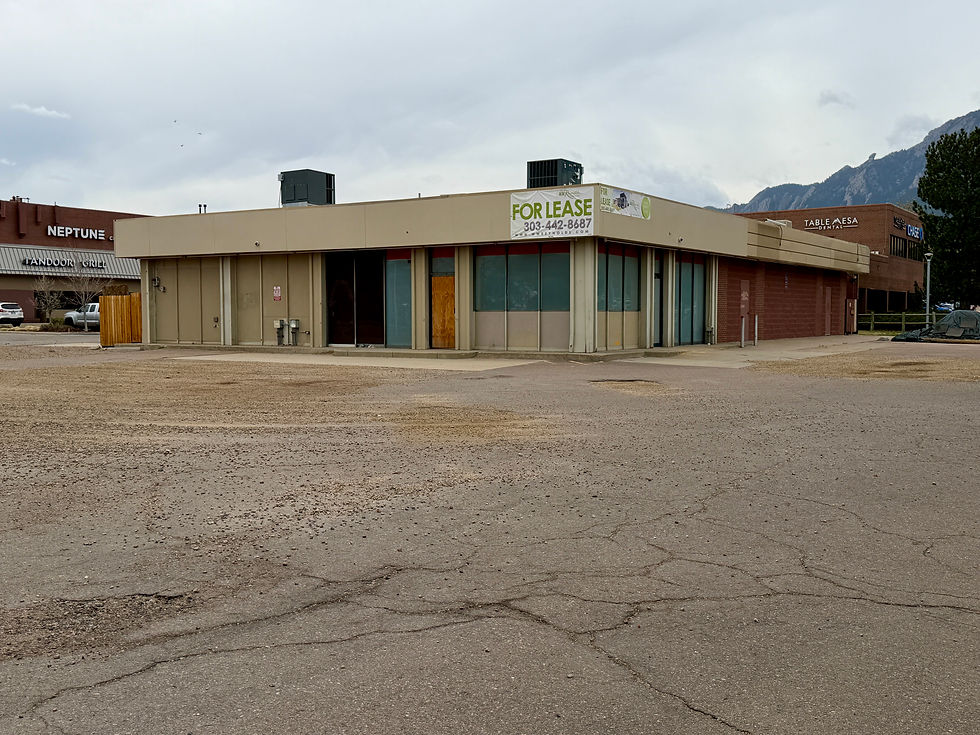
The former gas station at Broadway and Table Mesa (featured at the top of this newsletter). Abandoned and neglected for roughly a decade, a visible eyesore on one of our busiest corridors. A redevelopment application was finally filed in late 2024. As of this writing, the space is still empty. Would a vacancy tax have prevented 10 years of neglect? I don't think so. What would have helped is a faster permitting process and a city that actively enforces property maintenance standards.
The former Alfalfa's Market at Broadway and Arapahoe. Closed in early 2021, this 37,000-square-foot space on one of Boulder's most prominent intersections took five years to begin filling, and portions remain vacant today. The market wanted to adapt. The regulatory process made it painfully slow. Even though there are some tenants inside, the giant “For Lease” sign paints a bleak and unpleasant picture for the community.
The former Millennium Hotel on 28th Street. A 15-acre site that sat vacant for years before demolition for student housing, a project that won't be completed until 2027. The market eventually found a use. It just took too long.
These properties share something in common: they're all on major transit corridors and high-visibility intersections. They shape how people feel about our community every single day. And in every case, what made them eyesores wasn't a missing tax, it was slow processes, rigid regulations, and insufficient enforcement of basic property maintenance.
There's another trend worth watching. Since COVID, second-floor office spaces in our downtown core have been largely empty. But what we're starting to see now is that vacancy is leaking to the ground floor, noticeably more empty storefronts over the last several months. As our macroeconomic situation trends toward uncertainty, adding a commercial vacancy tax that makes it more expensive for businesses to get started, or to hang on, feels like the wrong tool at the worst possible time.
That's not a vacancy problem. That's a blight problem. And the city should be enforcing community stewardship through blight standards, not taxing vacancy as a proxy for neglect.
What's already happening
The good news: we're moving in the right direction. The city's Office of Cultural and Economic Development will begin tackling commercial vacancy more aggressively once several priority initiatives are completed, including the Downtown Development Authority, the Metropolitan District framework, and regulatory preparations for the Sundance Film Festival. Once these are substantially underway, staff will focus specifically on the office vacancy challenge as part of our broader Economic Development Strategy. Expect updates later this summer and into fall.
Meanwhile, the comprehensive plan update and the city's commitment to rewrite Title 9, along with changes to our permitting and planning processes, will have a direct impact on commercial office vacancy. These reforms will streamline how property owners convert, adapt, and remodel their spaces, making Boulder a more attractive place for businesses.
This work matters because the solution to vacancy isn't punishment, it's removing barriers and making Boulder worth choosing.
Residential vacancy tax — yes. I support it and council is already working on it.
Commercial vacancy tax as proposed — no. It misdiagnoses the problem, ignores the financing constraints landlords face, and lets the city off the hook for its own role in creating vacancy.
Blight enforcement — yes. Use the tools we have, more aggressively.
Regulatory reform — yes. Clear the barriers so commercial spaces can adapt.
Economic development — yes. Make Boulder worth the premium.
I'm not asking you not to care about vacancy. I'm asking you to make sure the solution matches the problem. Right now, this petition doesn't.
A message to the petition organizers
I want to speak directly to the people behind Vacancy to Vitality, because I believe you're well-intentioned. You see a real problem and you want to fix it. I respect that.
But I'd ask you to consider something: the commercial vacancy tax is a poison pill in your own petition. A residential vacancy tax polls well, has proven results in other cities, and has broad support, including mine and many on Council. Council is already working on one. If you brought your energy, your signatures, and your organizing to the table to help us pass a strong residential vacancy tax, we could get this done. Together.
The commercial piece, on the other hand, will draw fierce opposition from the business community, commercial property owners, and a lot of residents who understand the market dynamics. It puts the entire measure at risk, including the residential tax that we all agree on.
Drop the commercial component. Work with the city. Let's take the win that's right in front of us, a residential vacancy tax that's strong, enforceable, and built to last. Then let's tackle the commercial vacancy challenge the right way: by removing the regulatory barriers, investing in economic development, and holding bad actors accountable through targeted enforcement.
The easy, measurable win is right there. Let's not lose it by overreaching.
If you found this helpful, I'd appreciate you forwarding it to friends and neighbors. If you havnt already please feel free to sign up to my Newsletter HERE. The more people understand the full picture, the better decisions we'll all make together.
As always, thank you for being engaged, asking hard questions, and caring deeply about Boulder’s future.
Matt Benjamin
Boulder City Council


Comments